


Page 63 - ENT 2026 e-program book final
P. 63
Less clogging
HALO Precision COBLATION Durability
WEREWOLF Less clogging HALO Precision COBLATION
For patients who have CRS with nasal polyps Durability WEREWOLF Less clogging HALO Precision
A PATH TO RAPID, COBLATION Durability WEREWOLF Less clogging HALO
Precision COBLATION Durability WEREWOLF Less clogging
SUSTAINED CONTROL 1,2 HALO Precision COBLATION Durability WEREWOLF Less
clogging HALO Precision COBLATION Durability WEREWOLF
Less clogging HALO Precision COBLATION Durability
WEREWOLF Less clogging HALO Precision COBLATION
Durability WEREWOLF Less clogging HALO Precision
COBLATION Durability WEREWOLF Less clogging HALO
Precision COBLATION Durability WEREWOLF Less clogging
HALO Precision COBLATION Durability WEREWOLF Less
DUPIXENT targets IL-4 and IL-13, key and central drivers of type 2
inflammation, in CRS with nasal polyps 1,3,4 COBLATION™
50 % reduction in nasal congestion 1,a PROCISE™ MAX
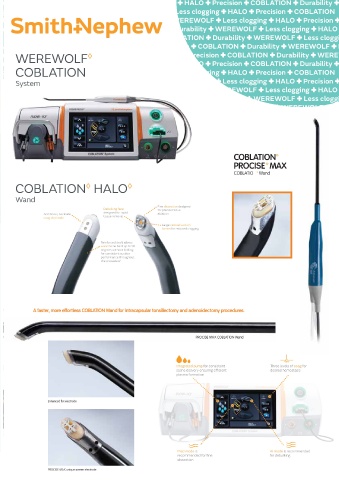
COBLATIO ™ Wand
83 % fewer patients required surgery or revision surgery 1
Debulking face
for precise tissue
designed for rapid Fine dissection designed
Additional, backside tissue removal ablation
coag electrode
74 % fewer patients required systemic steroids 1 Large central suction N
lumen for reduced clogging
Reinforced sha allows
wand to be bent up to 90
2 for consistent suction
degrees without kinking
> point improvement in polyp burden 1,b the procedure
performance throughout
2 3 patients were able to smell again 1,2,c
out
of
a -1.35 improvement at Week 52 (compared to a baseline score of 2.48) vs -0.37 improvement with placebo (compared to a baseline score of 2.38) (LSM difference: -0.98 [95% CI: -1.17,-0.79]). -1.25 improvement at A faster, more effortless COBLATION Wand for intracapsular tonsillectomy and adenoidectomy procedures.
Week 24 (primary endpoint) from a baseline score of 2.46 with DUPIXENT 300 mg Q2W + INCS (n=295, pooled DUPIXENT arms) vs -0.38 improvement from a baseline score of 2.38 with placebo + INCS (n=153) (LSM
difference: -0.87 [95% CI: -1.03, -0.71]). 1
b -2.24 from a baseline score of 6.07 (secondary endpoint) with DUPIXENT 300 mg Q2W + INCS (n=150) vs 3% worsening with placebo + INCS (n=153) (0.15 from a baseline score of 5.96) (LSM difference: -2.40 [95%
CI: -2.77, -2.02]). -1.71 improvement at Week 24 (primary endpoint) from a baseline score of 6.18 with DUPIXENT 300 mg Q2W + INCS (n=295, pooled DUPIXENT arms) vs 0.10 worsening from a baseline score of
5.96 with placebo + INCS (n=153) (LSM difference: -1.80 [95% CI: -2.10, -1.51]). 1
c Anosmia, UPSIT score ≤ 18: 79% (n=228/287) of patients in the pooled arm taking DUPIXENT 300 mg Q2W + INCS had anosmia at baseline, which was reduced to 30% (n=84/280) as per UPSIT score at Week 24.
PROCISE MAX COBLATION Wand
CRS, chronic rhinosinusitis; INCS, intranasal corticosteroids; LSM, least squares mean; Q2W, once every 2 weeks; UPSIT, University of Pennsylvania Smell Identification Test.
References: 1. DUPIXENT ® 300mg Pre-filled Syringe Hong Kong Prescribing Information. 2. Bachert C, et al. Lancet. 2019 Nov 2;394(10209):1638-1650. 3. Gandhi NA, et al. Nat Rev Drug Discov. 2016 Jan;15(1):35-50.
4. Schleimer RP. Annu Rev Pathol. 2017 Jan 24;12:331-357.
Presentation: Dupilumab solution for injection in a pre-filled syringe with needle shield. Indications: Atopic Dermatitis (AD): Moderate-to-severe AD in adults and adolescents ≥12 years who are candidates for systemic therapy; severe atopic dermatitis in children 6 months to
11 years old who are candidates for systemic therapy. Asthma: In adults and adolescents ≥12 years as add-on maintenance treatment for severe asthma with type 2 inflammation characterised by raised blood eosinophils and/or raised FeNO, who are inadequately controlled with
high dose ICS plus another medicinal product for maintenance treatment. In children 6 to 11 years old as add-on maintenance treatment for severe asthma with type 2 inflammation characterised by raised blood eosinophils and/or raised FeNO, who are inadequately controlled with Integrated pump for consistent Three levels of coag for
medium to high dose ICS plus another medicinal product for maintenance treatment. For 300 mg only – Chronic rhinosinusitis with nasal polyposis (CRSwNP): As an add-on therapy with intranasal corticosteroids for the treatment of adults with severe CRSwNP for whom therapy
with systemic corticosteroids and/or surgery do not provide adequate disease control. Prurigo Nodularis (PN): Moderate-to-severe PN in adults who are candidates for systemic therapy. Eosinophilic esophagitis (EoE): In adults and adolescents ≥12 years, weighing ≥40 kg, who saline delivery ensuring e cient desired hemostasis
are inadequately controlled by, are intolerant to, or who are not candidates for conventional medicinal therapy. Dosage & Administration: Subcutaneous injection. AD adults: Initial dose of 600 mg (two 300 mg injections), followed by 300 mg Q2W. AD adolescents (12-17y/o): plasma formation
Body weight <60 kg- initial dose of 400 mg (two 200 mg injections), followed by 200 mg Q2W. Body weight ≥60 kg- same dosage as adults. AD children (6-11y/o): Body weight 15kg~<60 kg- initial dose of 300 mg on Day 1 follow by 300 mg on Day 15, then 300mg Q4W. Body
weight ≥60 kg- same dosage as adults. * The dose may be increased to 200 mg Q2W in patients with body weight of 15 kg~< 60 kg based on physician’s assessment. AD children (6 months-5y/o): Body weight 5kg~<15 kg- initial dose of 200 mg, then 200 mg Q4W. Body weight
15kg~<30 kg- initial dose of 300 mg, then 300 mg Q4W. Dupilumab can be used with or without topical corticosteroids. Topical calcineurin inhibitors may be used, but should be reserved for problem areas only, e.g. face, neck, intertriginous and genital areas. Consider discontinuing
treatment in patients who have shown no response after 16 weeks. Asthma adults and adolescents: Initial dose of 400 mg, followed by 200 mg Q2W. For patients with severe asthma and on oral corticosteroids or with severe asthma and co-morbid moderate-to-severe AD or
adults with co-morbid severe CRSwNP- initial dose of 600 mg, followed by 300 mg Q2W. Asthma children (6-11y/o): Body weight 15kg~<30 kg- 300 mg Q4W. Body weight 30kg~<60 kg- 200 mg Q2W; or 300 mg Q4W. Body weight ≥60 kg- 200 mg Q2W. For paediatric patients
(6-11y/o) with asthma and co-morbid severe atopic dermatitis, as per approved indication, the recommended dose should follow AD children (6-11y/o). Patients receiving concomitant oral corticosteroids may reduce steroid dose gradually once clinical improvement with dupilumab
has occurred. The need for continued dupilumab therapy should be considered at least annually as determined by a physician. CRSwNP: Initial dose of 300 mg, followed by 300 mg Q2W. Consider discontinuing treatment in patients who have shown no response after 24 weeks.
PN: Initial dose of 600 mg (two 300 mg injections), followed by 300 mg Q2W. Dupilumab can be used with or without topical corticosteroids. Consider discontinuing treatment in patients who have shown no response after 24 weeks. EoE: 300 mg QW. Dupilumab 300 mg QW has Enhanced flat electrode
not been studied in patients with EoE weighing <40 kg. Dosing beyond 52 weeks has not been studied. For Missed dose instructions, please refer to the full prescribing information. Contraindications: Hypersensitivity to dupilumab or any of the excipients. Precautions: Not be
used to treat acute asthma symptoms, acute exacerbations, acute bronchospasm or status asthmaticus. Do not discontinue corticosteroids abruptly upon start of dupilumab. Reduction should be gradual and performed under supervision of a physician; it may be associated with
systemic withdrawal symptoms and/or unmask conditions previously suppressed by systemic corticosteroid therapy. Biomarkers of type 2 inflammation may be suppressed by systemic corticosteroid use. If systemic hypersensitivity reaction occurs, discontinue dupilumab and
initiate appropriate therapy. Be alert to vasculitic rash, worsening pulmonary symptoms, cardiac complications, and/or neuropathy presenting in patients with eosinophilia. Treat pre-existing helminth infections before initiating dupilumab. If patients become infected while receiving
dupilumab and do not respond to anti-helminth treatment, discontinue dupilumab until infection resolves. Cases of enterobiasis were reported in children 6 to 11 years old in the paediatric asthma development program. Advise patients to promptly report new onset or worsening
eye symptoms. Patients who develop conjunctivitis, dry eye and keratitis that does not resolve following standard treatment should undergo ophthalmological examination. Sudden changes in vision or significant eye pain that does not settle warrant urgent review. Patients with MAT-HK-2400663-1.0-09/24
comorbid asthma should not adjust or stop asthma treatments without consultation with physicians. Carefully monitor patients after discontinuation of dupilumab. Avoid using live and live attenuated vaccines concurrently with dupilumab. Patients should be brought up to date with
immunisations before starting dupilumab. Drug Interactions: Immune responses to TdaP vaccine and meningococcal polysaccharide vaccine were assessed. Patients receiving dupilumab may receive concurrent inactivated or non-live vaccinations. Pregnancy and lactation:
Should be used during pregnancy only if potential benefit justifies potential risk to foetus. Unknown whether dupilumab is excreted in human milk or absorbed systemically after ingestion. Decision must be made whether to discontinue breast-feeding or dupilumab taking into
account benefit of breast feeding for the child and benefit of therapy for the woman. Undesirable effects: Most common adverse reactions reported- injection site reactions, conjunctivitis, conjunctivitis allergic, arthralgia, oral herpes, eosinophilia and injection site bruising. Safety
profile observed in adolescents and children 6 months to 11 years old consistent with that seen in adults. For other undesirable effects, please refer to the full prescribing information. Preparation: 2 x 300mg/2ml in pre-filled syringe with needle shield, 2 x 200mg/1.14ml in pre-filled
syringe with needle shield. Legal Classification: Part 1, First & Third Schedules Poison Full prescribing information is available upon request.
API-HK-DUP-23.10
Med mode is Hi mode is recommended
Sanofi Hong Kong Limited recommended for fine for debulking
dissection
1/F & Section 212 on 2/F, AXA SOUTHSIDE, 38 WONG CHUK HANG ROAD, HONG KONG
Tel: (852) 2506 8333 Fax: (852) 2506 2537 PROCISE MAX unique screen electrode

