


Page 153 - HKU Surgery 110 Anniversary E-Book
P. 153
Chapter V.  Embracing the Modern Age


 Pursuing Innovation


 Expectations in research have undergone  clinical staff has multiplied to more
 a dramatic transformation. It is no  than 100, from under five in the mid-
 longer sufficient to develop new surgical  1990s. Initiatives such as the Tissue
 techniques, such as the maxillary swing  Bank and the Hereditary Breast Cancer
 by Professor William Wei or heroic  Family Registry database have provided
 liver transplantations by Professor ST  important tools for delving deeper into
 Fan and Professor Lo Chung-Mau.  disease mechanisms and outcomes.
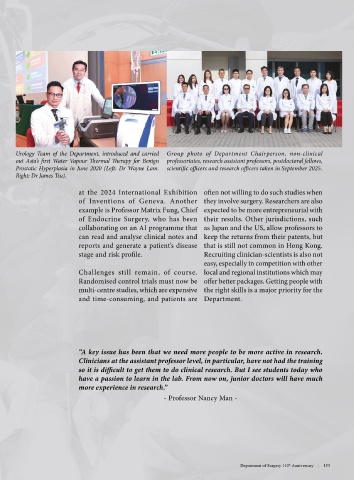
 Instead, researchers are expected to  Cancer care has also become a priority   Urology Team of the Department, introduced and carried   Group photo  of  Department  Chairperson, non-clinical
 produce scientific insights on disease  research area. The Department also has   out Asia’s first Water Vapour Thermal Therapy for Benign   professoriates, research assistant professors, postdoctoral fellows,
       Prostatic Hyperplasia in June 2020 (Left: Dr Wayne Lam.
                                                             scientific officers and research officers taken in September 2025.
 mechanisms, develop technology-based  some of the best outcome datasets in the   Right: Dr James Tsu).
 improvements in treatment that ideally  world because of Hong Kong’s small size
 can  be commercialised, and  pursue  and patient willingness to return for long-  at the 2024 International Exhibition  often not willing to do such studies when
 multidisciplinary collaboration – all  term follow-up. All of this has enabled   of Inventions of Geneva. Another  they involve surgery. Researchers are also
 of which require more scientists and  it to publish important studies in high-  example is Professor Matrix Fung, Chief  expected to be more entrepreneurial with
 funding. Fortunately, the Department        impact publications.  of Endocrine Surgery, who has been  their results. Other jurisdictions, such
 had some foresight in this regard and   collaborating on an AI programme that  as Japan and the US, allow professors to
 started recruiting laboratory scientists  Clinicians and scientists are working   can read and analyse clinical notes and  keep the returns from their patents, but
 in the 1990s. The pace has only ramped  together to develop new tools to advance   reports and generate a patient’s disease  that is still not common in Hong Kong.
 upwards.  research. For instance, Professor Nancy   stage and risk profile.   Recruiting clinician-scientists is also not
 Kwan Man and her team developed the                                      easy, especially in competition with other
 The Faculty as a whole has invested  Bionic Liver-in-Cube, which can be used   Challenges still remain, of course.  local and regional institutions which may
 in centralised facilities and trained  to test treatments and conduct research   Randomised control trials must now be  offer better packages. Getting people with
 technicians to support research. Within  and won the special grand prize of “Prize   multi-centre studies, which are expensive  the right skills is a major priority for the
 the Department, the number of non- of the China Invention Association”   and time-consuming, and patients are  Department.


                             “A key issue has been that we need more people to be more active in research.
                             Clinicians at the assistant professor level, in particular, have not had the training
                             so it is difficult to get them to do clinical research. But I see students today who
                             have a passion to learn in the lab. From now on, junior doctors will have much
                             more experience in research.”
                                                            - Professor Nancy Man -


 The world’s first ‘liver cube’.  Interdisciplinary research team of HKUMed develops world’s first
 AI model for thyroid cancer diagnosis, with over 90% accuracy
 and reduced consultation preparation time.

 152    |    Department of Surgery 110  Anniversary                                     Department of Surgery 110  Anniversary    |    153
                                                                                                         th
 th

