


Page 51 - HKU Surgery 110 Anniversary E-Book
P. 51
Chapter II: Hong Kong’s First Academic Surgical Unit


 Post-War Recovery           opening the Department’s doors to             an Orthopaedic and Trauma Unit was

                             students, it was up to his successor,
                                                                           founded to focus on spinal tuberculosis
                             Professor Francis Stock, to re-establish      and  poliomyelitis,  and it pioneered
 The post-war period was ver y   medical staff to oversee every patient’s   its teaching and research regimen. Stock   ground-breaking procedures, including
 difficult for everyone in Hong Kong.   care (in fact, a number of pre-war   had his work cut out for him, given the   the “Hong Kong Operation”. The unit
 In the  wake  of the  Sino-Japanese   staff had died during the war or left   minimal resources and very crowded   later became a department of its own in
 war and 1949 revolution in China,   Hong Kong shortly after,  including   conditions in hospitals. But, as only the   1961. A chair of paediatric surgery was
 hundreds of thousands of people fled   Digby). As a result, young doctors   second full-time professor of surgery   also established in 1962.
 to the city. The population ballooned   and even interns and students were   (after Digby), he was keen to raise
 from 500,000 in 1945 to 2.2 million   tasked with performing operations   standards and promote research. Over   Alongside these advances, though,
 in 1950 and kept growing by about   and other major responsibilities.   15 years as Professor of Surgery, from   Stock’s tenure was marked by tense
 one million people per decade to the   Fortunately, they had rigorous   1948 to 1963, Stock laid building blocks   relations with some of his colleagues.
 end of  the century. Incomes were   training and strict and demanding   for future success.  He was said to have not been on speaking
 low, living conditions were crowded   professors – all necessary for matters   terms with the government surgical
 and unsanitary, and medical services   of life and death, even though, for   Stock emphasised quality assurance, and   consultant, Dr John Chen, and to have
 struggled to keep up. At Queen Mary   a while, fewer than half of students   he reviewed all surgical complications   poor relations with the uncompromising
 Hospital, surgical wards were jam-  graduated. Talented and ambitious   and post-operative deaths at the weekly   Professor of Medicine, AJS McFadzean.
 packed with camp beds, a situation   students took advantage of the   Census Meeting, which remains an   (Interestingly, McFadzean hit it off with
 that persisted for decades.  opportunities  to  rise  through  the   important departmental activity today   Stock’s successor, GB Ong, who was
 Department’s ranks and inspired   for  learning, improving patient care   equally headstrong.) Stock left Hong
 The rapid increase in patient loads   others to follow.  and sparking research ideas. He notably   Kong in 1963 to continue a successful
 meant there were not enough senior   identified the need for specialisation,   career in the UK.
                             starting with orthopaedics. In 1951,
 Back on Track


 The Department of Surgery, and the rest   to provide medical training and thus
 of HKU, had to rebuild pretty much from   future doctors for a growing population,
 scratch when they reopened in 1946.   and in 1948, it resumed undergraduate
 Both Queen Mary Hospital and the   classes. Degrees were also awarded to
 University had been damaged in the   those students who had fled Japanese-
 war, including the Main Building which   occupied Hong Kong at the start of
 lost its roof. Dr John Gray was head of   the war and continued their studies in
 surgery at HKU and also Acting Head   Free China – including future head of
 of Surgery at Queen Mary Hospital – a   surgery, Professor GB Ong, and his wife,
 rather thankless task, evidenced by the   Dr Christina Chow. They were among 63
 scant information that remains about his   students to receive “war-time degrees”
 tenure from 1945-48.   between 1946 and 1948.


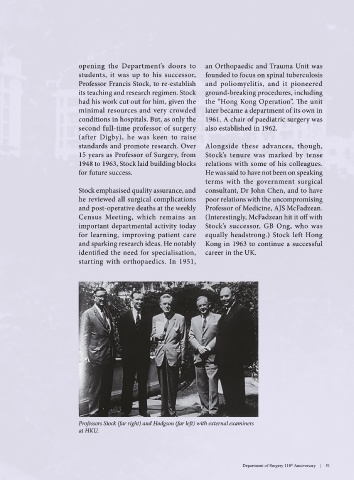
 HKU was still the only local institution   While Gray completed the task of   Professors Stock (far right) and Hodgson (far left) with external examiners
                             at HKU.


 50    |    Department of Surgery 110  Anniversary                                      Department of Surgery 110  Anniversary    |    51
                                                                                                          th
 th

