


Page 93 - HKU Surgery 110 Anniversary E-Book
P. 93
Chapter IV.  A Centre of Excellence


 Training the Next Generation


 The training of surgeons was also  Niv Patil who was also closely involved   For instance, in the gastrointestinal block,  Kong). Wong also introduced Chief of
 changing in the late 20th century, given  in the Faculty-wide medical curriculum   students studied the anatomy of the whole  Residents and a Deputy Chief of Residents
 the exponential growth in new medical  reform launched in 1997. That reform   gastrointestinal system, the physiology  to nurture younger Residents and serve as a
 knowledge and technologies that started  introduced problem-based learning in   of digestion, the pathology of the liver  bridge to senior management. (Appendix)
 to take off in the 1980s. In 1995, the  the pre-clinical years to give students   and so on. This approach also enabled the  Every morning post-call, Wong would lead
 Department established the Division, later  a more integrated, clinical approach to   early introduction of clinical skills, such  a meeting with the Chief and Deputy Chief
 Centre for Education and Training (CET) medicine. Rather than study pre-clinical   as abdominal examinations.   of Residents to stay on top of developments
 to sharpen its teaching programmes at  subjects as stand-alone topics, such as   of the previous night.
 both the undergraduate and postgraduate  anatomy or biochemistry, they focused   Surgical training also underwent changes
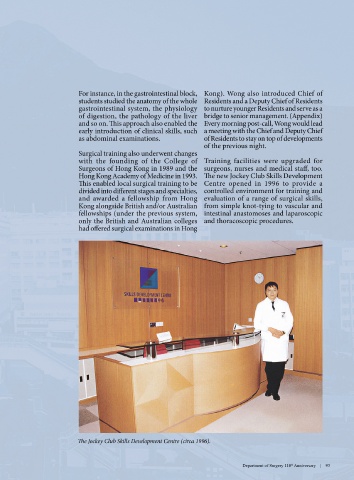
 levels. Surgical training became more  on them within different bodily systems.   with  the  founding  of  the  College  of  Training facilities were upgraded for
 structured and standardised.   Surgeons of Hong Kong in 1989 and the  surgeons, nurses and medical staff, too.
 Whereas the previous focus   Hong Kong Academy of Medicine in 1993.  The new Jockey Club Skills Development
 was on conditions particular   This enabled local surgical training to be  Centre opened in 1996 to provide a
 to Hong Kong, there was now   divided into different stages and specialties,  controlled environment for training and
 more comprehensive exposure   and awarded a fellowship from Hong  evaluation of a range of surgical skills,
 to every aspect of surgery and   Kong alongside British and/or Australian  from simple knot-tying to vascular and
 encouragement to students to   fellowships (under the previous system,  intestinal anastomoses and laparoscopic
 take forays into research.  only the British and Australian colleges  and thoracoscopic procedures.
                             had offered surgical examinations in Hong
 The CET was the first centre in
 Asia wholly devoted to surgical
 education and it became a nucleus
 of educational excellence. Its first
 Director was Professor Htut
 Saing, succeeded by Professor


 Members of the Centre for Education and Training in 2002.


 Patients’ Expectations


 Change


 In the 1970s and 1980s, hospital wards  Wong. “Patients when they first came
 were overcrowded and understaffed –  were incredibly compliant and grateful
 at night there would be one nurse, one  even if they were sleeping in the stairwell.
 student and an amah to look after more  Because at that time, you were lucky to
 than 50 patients and deal with emergency  get into a hospital and if you got into
 admissions – but the patients were not  a hospital like Queen Mary, it was like
 demanding, according to Professor  winning the lottery,” he said.
                             The Jockey Club Skills Development Centre (circa 1996).


 92    |    Department of Surgery 110  Anniversary                                      Department of Surgery 110  Anniversary    |    93
                                                                                                          th
 th

