


Page 143 - HKU Surgery 110 Anniversary E-Book
P. 143
Chapter V.  Embracing the Modern Age


 Getting Students Back


 in the Ward


 Surgical training is not the only area where  Kent-Man, Director of the Department’s
 things have changed. The undergraduate  Centre for Education and Training, to get
 years have also been affected by  students back in the real world.
 the changing student make-up and
 technology. Here, too, the Department  The Reform Curriculum  merges the
 and the Faculty have stayed on top of  junior and senior clerkships into three 16-
 the trends.  week blocks covering surgery, medicine,
 and multidisciplinary including a focus
 With larger class sizes and greater  on cancer, which gives students a
 diversity among students, the Faculty’s  longer time in each area to deepen their   The larger number of students admitted  towards ultra-specialists, but society also
 chief aim is now to ensure all students are  explorations (previously, they did eight   to the MBBS each year means there is a  wants more general practitioners.”
 equipped with the relevant knowledge,  weeks of each area in each of the junior   wider range of abilities. And that is not a
 skills and behaviours that are essential  and senior years). It has also transformed   bad thing, says Professor Stephen Cheng. The  Faculty  also  understands  who  it
 to becoming safe and competent doctors,  the specialty clerkship into the Assistant   is dealing with, said Professor Chu
 while also encouraging excellence. In the  Internship that requires students to spend   “Before, all the applicants we admitted  Kent-Man, and in some ways it is not
 “Enrichment Year” in third year, students  more time on the wards and participate   were straight A students. Now, we  so different from the past. “The thing
 undertake service, research or pursue  in patient care (starting from January   accept less capable students because the  that has not changed is that they are still
 another area of study or degree; many  2026). Learning from websites and books   numbers are increasing. But then maybe  secondary school students. They like us
 spend time overseas, living on their  may seem a shortcut to acquiring lots   healthcare doesn’t need so many GB Ongs.  to feed them knowledge. There are still
 own for the first time. Teachers are also  of knowledge, but the most effective   The government wants more primary  good students, but also some who are not
 getting assistance to cope with the higher  lessons come from being around patients   healthcare  and  general  practitioners  so good, so we want to make sure they
 workload through online platforms and  themselves.  to look after people in the community.  all achieve a minimum standard before
 AI-generated questions, which a Faculty   They cannot all be ultra-specialists. The  they graduate.”
 study found were comparable to teachers   structure at Queen Mary Hospital is
 writing their own questions.

 Other learning technologies are also
 being embraced, enabling students to
 learn online, do things such as explore
 anatomy through virtual reality and wield
 portable ultrasound probes. However, this
 has also meant students are glued to their
 screens. In 2024, the Faculty introduced
 the new Reform Curriculum, an exercise
 that closely  involved  Professor  Chu


 “We observed that many students were staying in the library rather than the wards.
 They may feel they gain more from reading books than taking the extra time to gain
 knowledge in the ward. But that is not true. They will always learn more in the
 ward. Technology can assist, but the most important thing is still real-life exposure.”
 - Professor Chu Kent-Man -


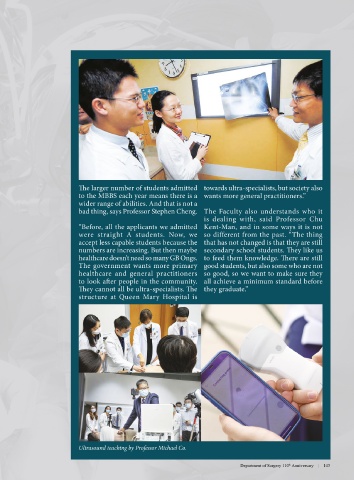
                             Ultrasound teaching by Professor Michael Co.


 142    |    Department of Surgery 110  Anniversary                                     Department of Surgery 110  Anniversary    |    143
                                                                                                         th
 th

