


Page 67 - HKU Surgery 110 Anniversary E-Book
P. 67
Chapter III. Putting Hong Kong Surgery on the World Map


                                         Doing More with Less


                             Researchers did not have much in              The lack of research training hindered
                             the way of laboratory equipment or            outcomes, though, said Professor KH
                             facilities, so they focused on clinical       Lam. “We did so-called research every
                             cases, collecting the data by hand.           Friday afternoon. We would go to the

                                                                           animal laboratory on Sassoon Road
                             As Professor John Wong recalled:              – it was very primitive with mainly
                             “When I first came, research was              dogs. As I remember it, it was GB’s

 Adapted from British Journal of Surgery, 1964 .  basically to record or summarise a   idea to use them to prepare for liver
 10
                             patient’s age, sex, disease, diagnosis,       transplants. There would be me and
                             operation, etcetera, onto a card a little     another classmate and two senior
                             bigger than A4 with holes punched             surgeons. We would anaesthetise
 Letter from the patient who underwent Hong Kong’s
 first kidney transplantation in 1969.  at the top and sides. Each hole    the dogs, cut out the liver and try
                             corresponded with a different item.           to protect it. But we never succeeded
 The Department’s clinical space also grew as Ong expanded his “empire”   We had a file cabinet with the cards   in keeping the dog alive. We also
 over his 18 years as Head. In 1964, when he arrived, the Department was   and to do research, you would get a   operated to remove the oesophagus,
 responsible for 92 beds in Queen Mary Hospital. By his retirement in 1982,   long, steel narrow wire or stick and   using the intestine to replace it, and
 it had 800 beds across four hospitals: Queen Mary Hospital, Kwong Wah   thread that through the holes you were   tested whether blood supply from the
 Hospital, Grantham Hospital for the cardiothoracic unit, and Tung Wah   interested in and pull those cards out.   skin could go into the intestine. It
 Hospital for day surgery and convalescence.
                             It was rudimentary, but still we got          was very primitive research, not well

                             published.”                                   thought out. I thought it was a waste
                                                                           of time.”


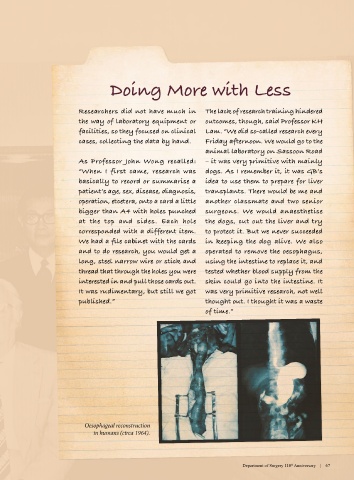
                               Oesophageal reconstruction
                                   in humans (circa 1964).


 66    |    Department of Surgery 110  Anniversary                                      Department of Surgery 110  Anniversary    |    67
                                                                                                          th
 th

