


Page 61 - HKU Surgery 110 Anniversary E-Book
P. 61
Chapter III. Putting Hong Kong Surgery on the World Map


 General Surgery is King     Rounds with ‘Napoleon’


                             Hospital conditions were still  affairs where Ong demanded details
                             relatively poor during Ong’s reign  about cases gone wrong. But his
                             due to serious overcrowding. The  insistence on answers had an upside
                             surgical wards were located on the  that is rarely seen today: Residents
                             fifth floor of Queen Mary Hospital  were often dispatched to autopsy
                             and consisted not only of dozens  sessions to learn more about the case,
                             of hospital beds but also foldable  an experience that also reinforced
                             camp beds – a piece of canvas strung  their understanding of anatomy,
                             between two rattan rods – that filled  pathology and surgery.
                             corridors and even the lift lobby with
 Ong’s ideas on how the Department  even had a competition going with   the overflow of patients. There was
 should be organised differed from  Professor Komei Nakayama of Japan   also no air-conditioning.
 his predecessor Stock and successor  over who was the fastest surgeon.) He
 Wong, who both saw value in greater  especially liked to do big, complicated   None of this prevented Ong from
 specialisation (Wong would increase  operations, such as those involving   insisting all 50 or so Department staff
 sub-specialty divisions from five to  the liver and multiple blood vessels.  join his twice-weekly rounds. They
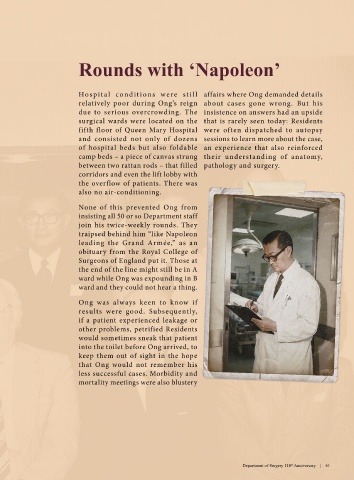
 13). Ong was a committed generalist   traipsed behind him “like Napoleon
 who insisted that all staff be general  However, Ong’s haste had a downside.   leading the Grand Armée,” as an
 surgeons,  too.  He  still  encouraged  For example, the 30-day mortality   obituary from the Royal College of
 them to acquire specialty skills and  for esophagectomy, one of Ong’s   Surgeons of England put it. Those at
 arranged for training overseas, but  specialities,  was  25%,  meaning   the end of the line might still be in A
 he assigned staff their specialties –  one in four never left hospital. A   ward while Ong was expounding in B
 there was little choice. People with  contributing factor was the high   ward and they could not hear a thing.
 specialist training were also still  rate of post-operative anastomotic   Ong was always keen to know if
 expected to perform general surgery  leakage. Wong would substantially   results were good. Subsequently,
 and be on call at night, even if, say a  improve that situation in future years,   if a patient experienced leakage or
 breast surgeon found it difficult to  bringing mortality to near zero.   other problems, petrified Residents
 perform an emergency abdominal   would sometimes sneak that patient
 operation.   “I remember when I saw GB on my   into the toilet before Ong arrived, to
 first day, I told him the areas I was   keep them out of sight in the hope
 Ong himself had no such difficulties.  familiar with and the areas I didn’t   that Ong would not remember his
 As far as he was concerned, nothing  have much experience in. The first   less successful cases. Morbidity and
 was beyond his surgical abilities.  thing he did was put me down for   mortality meetings were also blustery
 He was the archetypal  “general  everything I didn’t have experience
 surgeon”, performing more than  in. I said, whoa, you expect me to
 10,000 major operations over the  do all of that in one day? But he
 course of his career and relishing  was always in control, an expert
 the speed at which he worked, doing  operator.”
 up to five operations a day when   - Professor John Boey -
 most surgeons would do two. (Ong


 60    |    Department of Surgery 110  Anniversary                                      Department of Surgery 110  Anniversary    |    61
                                                                                                          th
 th

